The Map of Africa Opening: Story, Tides & Photo Tips

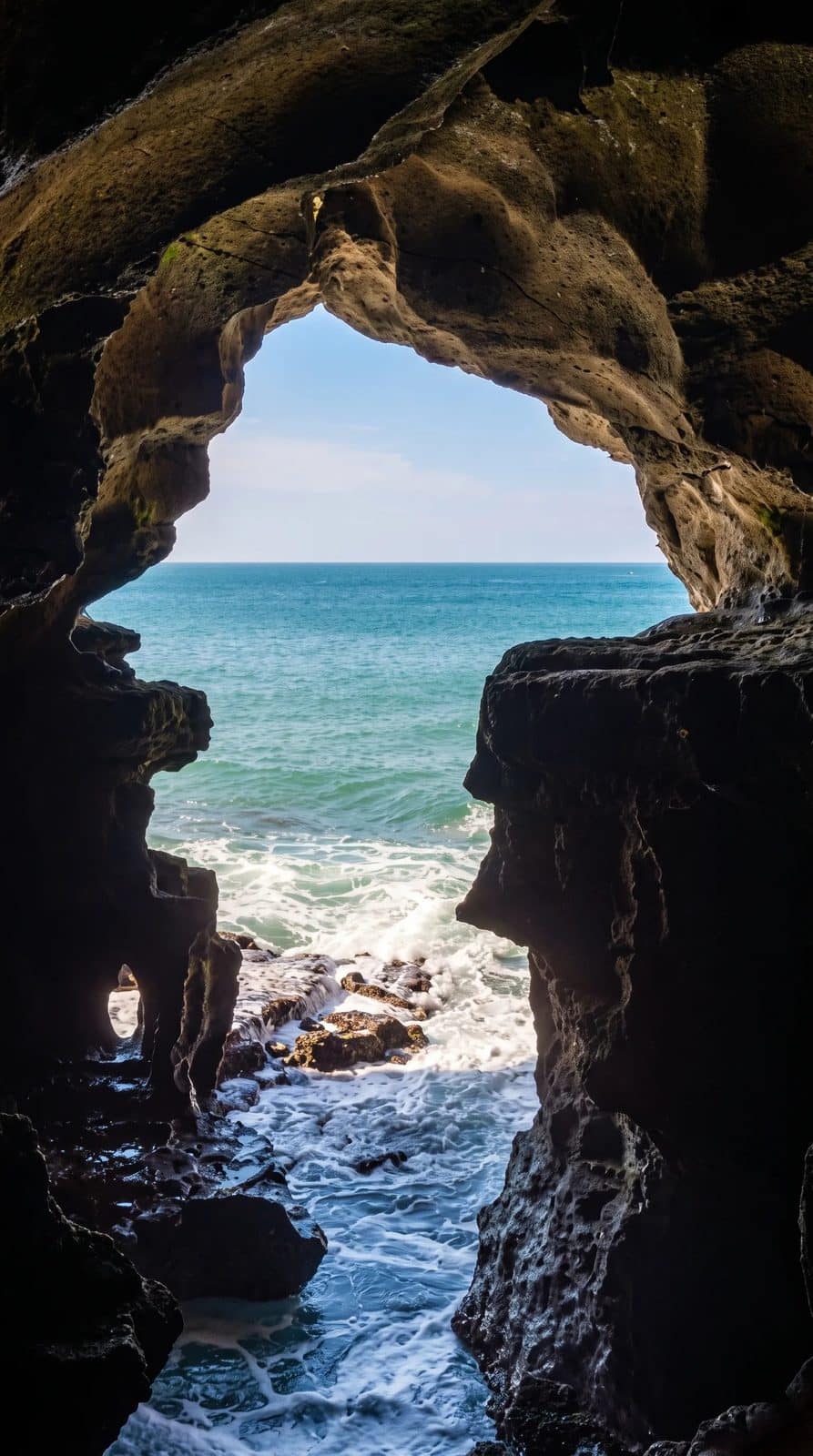
Every photo you’ve seen of the Caves of Hercules before visiting is probably this exact view: a jagged rock window facing the open Atlantic, roughly tracing the outline of the African continent. It’s earned the attention — but there’s more going on at this specific spot than the shape alone.
Why it’s famous
The opening is a natural formation, shaped by wave action and erosion rather than by design, and its resemblance to the African continent is what gave it its name. It’s also the feature most tightly bound up with the site’s Hercules mythology and its connection to the Pillars of Hercules — we cover that fuller story, including what’s legend and what’s documented history, in the Hercules legend and the cave’s real history.
What’s actually happening below it
Firsthand, standing at the opening: the Atlantic swell breaks directly against the rock just below the window, and at high tide, spray reaches up into the cave itself. It’s not a passive, framed view like a picture window — you can feel the ocean’s presence at this spot in a way photos alone don’t convey. If you’re visiting with kids or anyone who startles easily, it’s worth knowing in advance rather than being caught off guard by a wave.
Best conditions for photos
Two separate things affect how the shot turns out, and they don’t always line up:
- Light. The opening faces the ocean, which means you’re generally shooting into backlight — the sky and water outside the opening will read much brighter than the cave interior around you. Expose for the outside view and let the cave interior go darker and more silhouetted, rather than trying to balance both. Our best time to visit guide covers how the light through the opening changes across the day in more detail.
- Tide. High tide brings the dramatic version — visible spray, more motion, a more forceful sense of the ocean. Low tide gives a calmer, clearer view of the water beyond the opening, better if you want a cleaner shot without spray on your lens. Neither is objectively “better” — it depends on which version you’re after.
Practically: bring a lens cloth if you’re shooting near high tide, and keep a phone or camera on a wrist strap rather than held loosely near the opening’s edge. Our full photography guide to the caves covers the rest of the interior beyond just this one shot.
Bonus: the two-seas signpost outside
Just outside the caves, along the Cap Spartel road, there’s a wooden signpost marking the point where the Mediterranean and the Atlantic meet — labeled in French and Arabic (“Mer Méditerranée” / “Océan Atlantique”). It’s a small, easy-to-miss detail, but it’s a good complementary photo if the Map of Africa opening is the “framed” version of this same idea — the ocean meeting the sea — and the signpost is the literal, spelled-out version of it.
Before you go
Sort your entry ticket before you travel if you would rather not queue at the booth, which sits inside the cave entrance rather than out front.
Time your visit using our best time to visit guide if the opening is your main reason for going, and see our full walkthrough of what’s inside the caves for what comes before you reach it.
Caves of Hercules Team
Local visitor guides
We write and fact-check every guide from firsthand visits to the Caves of Hercules and Cap Spartel, so you can plan with confidence.